Time Management - Start your day wisely
Time management is an issue that everyone approaches differently, learns to manage it or perceives it as a problem and is in a constant struggle, which ultimately negatively affects both your physical and mental state. Determining in advance how you spend each hour of the day is vital to your success and productivity.
What is time management?
Time management is the art of effectively planning your time. It allows you to efficiently, productively complete the tasks you need to do within the appropriate time frames. This involves prioritizing your to-do list to separate urgent and important tasks, which will help you avoid deadlines and complete important tasks on time.
Here are some strategies and tips to help you effectively manage every second of your time. Remember - your time is valuable and valuable.
Find out how and what you spend your time on
To optimize your personal time, you first need to figure out what you're spending it on. Try diligently organizing your time by writing down and updating your daily activities for a week, which will help you:
- Determine how many tasks you have completed during the day;
- Identify the activities that took up the most time;
- Focus on the tasks.
This process will make it quite clear how much time you spend on unproductive thoughts, conversations, and activities. You will determine when you are most productive during the day, and you will know when to work on difficult tasks that require the most attention and creativity.
It is important to observe how realistically you estimate your working time. Compare how much time it took you to complete a certain task or project, we often overestimate what actually takes less time. Take this detail into account when drawing up a daily schedule, be sure of your real capabilities.
Determine priorities.
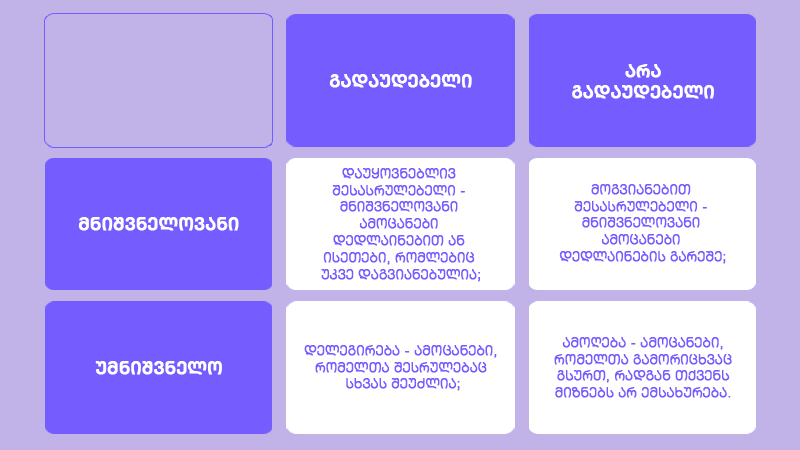
To manage your time effectively, it is important to draw a clear line between what is important and what is urgent. Experts agree that the most important task is usually not the most urgent. However, we tend to let many urgent tasks dominate our daily schedule. The Eisenhower Matrix can help you prioritize. In the time management matrix, activities are divided into four quadrants:
Create a daily schedule and stick to it.
This step is crucial to managing your time at work. Don’t start your day without an organized list of tasks you need to complete throughout the day. At the end of your workday, create a to-do list for the next day, which will allow you to start your day as soon as you get to the office. By writing everything down, you can avoid anxiety and constantly thinking about the tasks you have to do. Waking up with a clear mind will make your day more productive and you will start your work with new ideas. If you do this, you will ensure that the time you spend creating a clear plan is nothing compared to the time you will waste in inconsistently completing tasks.
Group similar tasks together.
Completing one type of task before moving on to a new one can save you time and energy. Grouping similar tasks together and doing them together can help you save time and motivate yourself. For example, set aside separate blocks of time to make phone calls, write messages, and respond to emails. Don’t respond to emails and texts as soon as you receive them, as this can be distracting.
Avoid the urge to multitask
This is the simplest time management tip, but it can be one of the hardest to follow. Focus on your work and stay focused. It can be tempting to multitask, but doing so will only set you back a step. Psychological studies have shown that multitasking doesn’t save time, in fact, it has the opposite effect. You waste time and reduce productivity by switching from one task to another. Try not to overload your daily schedule, constantly stressing about the work to be done (“I have so much to do”) will not shorten your to-do list, take a breath, divide it correctly and complete each one in stages.
Set limits.
Part of creating your daily schedule should include setting time limits for tasks - giving each task a specific amount of time to complete and, for greater accuracy, a time frame in which you will complete the task (maybe in 20 minutes, but in the evening), rather than just following through and working until the list is complete. To-do lists are all well and good, but sometimes they can create the illusion that you are never getting anything done. If you are struggling to maintain a steady pace in your work process, break your tasks into specific stages and take short breaks in between. This technique balances your pace, reduces mental strain, and keeps you motivated.
Learn to say no.
You will have a hard time managing your time at work if you don’t learn to say no. Only you know what you have time for, so if you need to say no to someone else’s help, do so.
It would be better to set aside time for helping others in your tasks and, instead of saying no, set aside time when you can help them – this way you will both complete your work successfully and be more empathetic to others. This advice may seem difficult at first, but it will make it clearer to you how valuable your time and competence are.
More organization
Organization should be an integral part of your daily routine. Studies have shown that clutter has a negative impact on your daily life (Roster, 2016). If you have piles of papers scattered all over your desk, finding the paper you need is like finding a needle in a haystack. I agree, there’s nothing more difficult than wasting your time. Create systems for organizing and completing tasks to increase your efficiency. You can follow the “keep,” “give away,” and “throw away” principle and use this method to reorganize things.
The next step is to improve the time you spend processing information. For example, to combat time wasted on email, implement a system that allows you to process information as efficiently as possible. Use folders or a color-coded system to keep track of information.
Stop wasting time.
People procrastinate on tasks for a variety of reasons. It could be that the task is uninteresting or unpleasant. To stop wasting time, consider this quote attributed to Mark Twain: “If your job is to eat a frog today, you had better do it in the morning. If your job is to eat two frogs, you had better eat the big one first.”
“If it’s your job to eat a frog today, it’s best to do it first thing in the morning. And if it’s your job to eat two frogs, it’s best to eat the big frog first”.
The tasks that we procrastinate on are called "big frogs." Complete these tasks early in the day to ensure they are completed on time. Another option for completing your tasks is the "snowball" method - break them down into smaller chunks, complete smaller tasks first, and then move on to larger tasks. Which method you choose is up to you, but the main thing is to create a reward system for completing them to stay motivated.
Mastering time management is a skill that can transform your personal and professional life. By understanding the importance and benefits of time management, and implementing practical strategies, you can maximize your potential, achieve your career goals, and live a fulfilling life. Successful time management leads to greater personal happiness and allows you to take new steps towards development.
Many people have ideas, but only Lemons.ge has solutions!
Lemons.ge team is always by your side when you need creative vision and real results.
Address: 117a Tsereteli Ave.
Contact: ( 995) 032 2 45 01 01

Other News